Growing Right Alongside Them
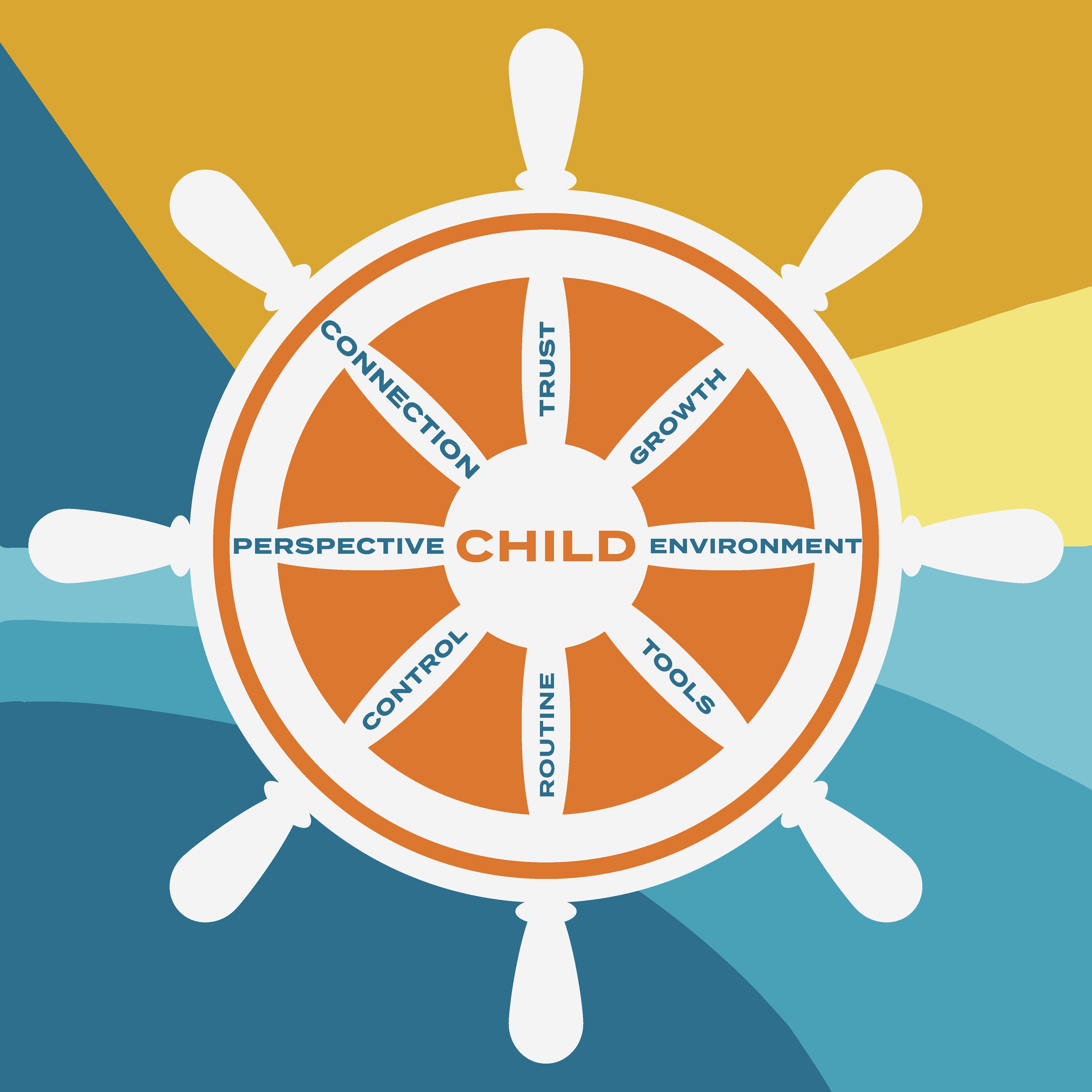
The Parenting Helm, a guide for navigating the many parts of parenting. This month, we’re exploring Control + Growth and the balance between guiding our children and giving them room to grow.
This month, we’re moving around the Parenting Helm to Control + Growth.
As our kids grow, parenting changes too. The choices get bigger, the mistakes get bigger, and we have to figure out when to step in and when to step back. And that is not always easy.
We want to protect them. We want to guide them. We want to help them make good choices. But we also have to give them room to grow, make mistakes, and figure things out.
And where we keep ending up is trust. So much of that balance between control and growth comes down to trusting our kids, trusting ourselves, and trusting the relationship we’re building along the way.
So, we’ve been thinking about consequences, discipline, trust, and what we’re really trying to teach our kids along the way.
PARENTING IS FUN!
Yes! And also, no!
Becoming a parent has been hands down the most transformative process I have ever lived through.
Think you know yourself? Have a child.
Think you have it all figured out? Have a child.
Think you need something to fill your free time? HAVE A CHILD.
In all seriousness, the past year of my life has been a lovely reminder that adulting has many levels I have yet to unlock, with so many fun bonus side quests I never imagined possible.
Learning how to live your life on a year of no sleep? A fun one!
Ever thought you would spend so much time thinking about wake windows? A must-not-miss thriller!
I have had to find comedic relief amongst the days of burnout and strife. Because ultimately, this experience of being someone’s parent—still a crazy concept for me, by the way—is an opportunity for growth as a person.
Learning to parent isn’t just about what we hope to pass on to our children in life lessons. It’s also about how we are choosing to encapsulate this moment in time with our young children that we will never get back.
And maybe that’s one of the first lessons in Control + Growth: our children aren’t the only ones growing.
We are too.
What Could Possibly Go Wrong?
I came across this quote again recently. I had read it before, but I hadn’t thought about it in a while.
“Discipline is helping a child solve a problem. Punishment is making a child suffer for having a problem. To raise problem solvers, focus on solutions, not retribution.” — L.R. Knost
And it was a good reminder.
Because parenting in the actual moment is hard.
Your child does something they know they shouldn’t do. Maybe you’ve already talked about it ten times. Maybe you’re tired. Maybe everyone is tired. And your first thought is: Okay, there needs to be a consequence.
I’ve been there plenty of times.
Or sometimes I just say it out loud: “There is going to be a consequence!”
Meanwhile, I have absolutely no idea what that consequence is going to be. I just said the word. And at that point, what does it even mean?
Rather than throwing out a consequence because I’m frustrated, maybe the better question is:
What am I trying to teach here?
What’s the takeaway? What do I actually want my child to learn from this?
That question changes things for me.
It doesn’t mean there aren’t consequences. Of course there are. Kids need boundaries, and sometimes they need really firm ones. They need to know when they’ve hurt someone, crossed a line, or made a choice that isn’t okay.
But I don’t want the goal to be making my child feel bad enough that they won’t do it again.
I want them to understand what happened and know what to do differently next time.
Sometimes that means fixing what they broke. Cleaning up the mess. Apologizing. Trying the conversation again. Taking some space. Losing access to something because they showed they weren’t ready to handle it responsibly.
The consequence should make sense. It should connect to what happened. It shouldn’t just feel like a punishment we hand down because we’re mad.
And maybe sometimes it’s less about the consequence and more about the conversation.
What happened?
What could you have done differently?
What do you need to do now?
How do we make this right?
Because underneath all of this is something I think is even more important: trust.
Trust might be one of the most important things we can build with our children.
If they don’t trust us, how do we work through the hard stuff together?
I want my kids to know they can tell me when they’ve messed up. That we can have hard conversations. That I may not always agree with them, and they definitely aren’t going to love every boundary I set, but we can work through it together.
Because we have to work together.
And I think that becomes even more important as our children grow.
Parenting has stages. When our kids are little, we do so much for them. We keep them safe, set the routines, hold the boundaries, make the decisions, and step in constantly.
And then they grow.
Our relationship has to grow with them.
A five-year-old needs something different from us than a ten-year-old. A teenager needs something different again. And absolutely, parenting gets harder as they get older.
The choices get bigger. The mistakes get bigger. And sometimes the consequences aren’t even ours to give anymore.
They are the natural consequences that come with life, friendships, school, work, driving, relationships, and all the independence we’ve been working so hard to help them build.
When they’re little, we can step in and fix a lot, but as they get older, we can’t always do that. And we probably shouldn’t.
That’s where trust matters so much.
I want my kids to know that when they make a mistake—and they will—they can come to me. Not because I’m going to fix it for them or make it disappear, but because we can talk about it, work through it, and figure out what comes next.
Little by little, we have to give them more room.
More room to make choices. More room to disagree with us. More room to get something wrong. More room to figure out what comes next.
They need to trust that they can come to us, even when they’ve messed up. And we have to trust them enough to give them opportunities to figure things out.
That can be hard.
Sometimes stepping in and fixing the problem ourselves is easier. Sometimes handing out a consequence and moving on is easier too.
But eventually, we have to step back.
Not disappear. Not stop parenting. Just change how we parent.
And sometimes what looks like “bad behavior” is really a child who doesn’t quite know how to handle frustration, disappointment, anger, embarrassment, or hearing “no.”
They’re still learning.
And I am too. Ha!
I definitely don’t always get this right. There are moments when I react, moments when I’m frustrated and just want the behavior to stop. Moments when I step in too quickly, and others when I realize later that I could have handled something differently.
That’s parenting.
I’m growing right alongside my kids, and the relationship is going to keep changing.
So maybe the question isn’t only:
What should the consequence be?
Maybe it’s:
What do I want my child to know after this?
Because one day my kids will be out in the world without me standing next to them.
They’ll mess up. They’ll hurt someone’s feelings. They’ll get angry. They’ll make bad decisions. They’ll face problems I can’t fix for them.
And they’ll have to figure out what to do next.
I want my kids to know how to do that.
I want them to know how to take responsibility. How to repair something when they’ve gotten it wrong. How to have a hard conversation. How to solve a problem. How to make a different choice next time.
But more than anything, I want them to know they can come to me.
At five. At ten. At sixteen. At twenty-five.
The way I parent them will have to change along the way. The boundaries will change, and the problems will change.
But I hope the trust is always there.
That’s the part of what I’m building through all these stages of parenting. Not children who are afraid to get it wrong, but children who know how to work through it when they do.
Keep Growing!
We may be parenting in different stages, but that might be one of the best parts of writing the Parenting Helm together.
One of us is navigating the early years, where everything is new, and parenting itself feels like one giant lesson in letting go of what you thought you knew.
The other is a little farther down the road, where independence is growing, the stakes feel a little bigger, and figuring out when to step in—and when not to—is becoming part of the work.
But the more we talk about it, the more we realize we keep coming back to the same things.
We’re trying to raise kids who know they are loved, who know how to make mistakes and repair them, who trust themselves, and who trust that they can come to us when things get hard.
And somewhere in all of that, we’re learning too.
Different stages. Different challenges. Plenty we’re both still figuring out.
Our children are growing.
And so are we.