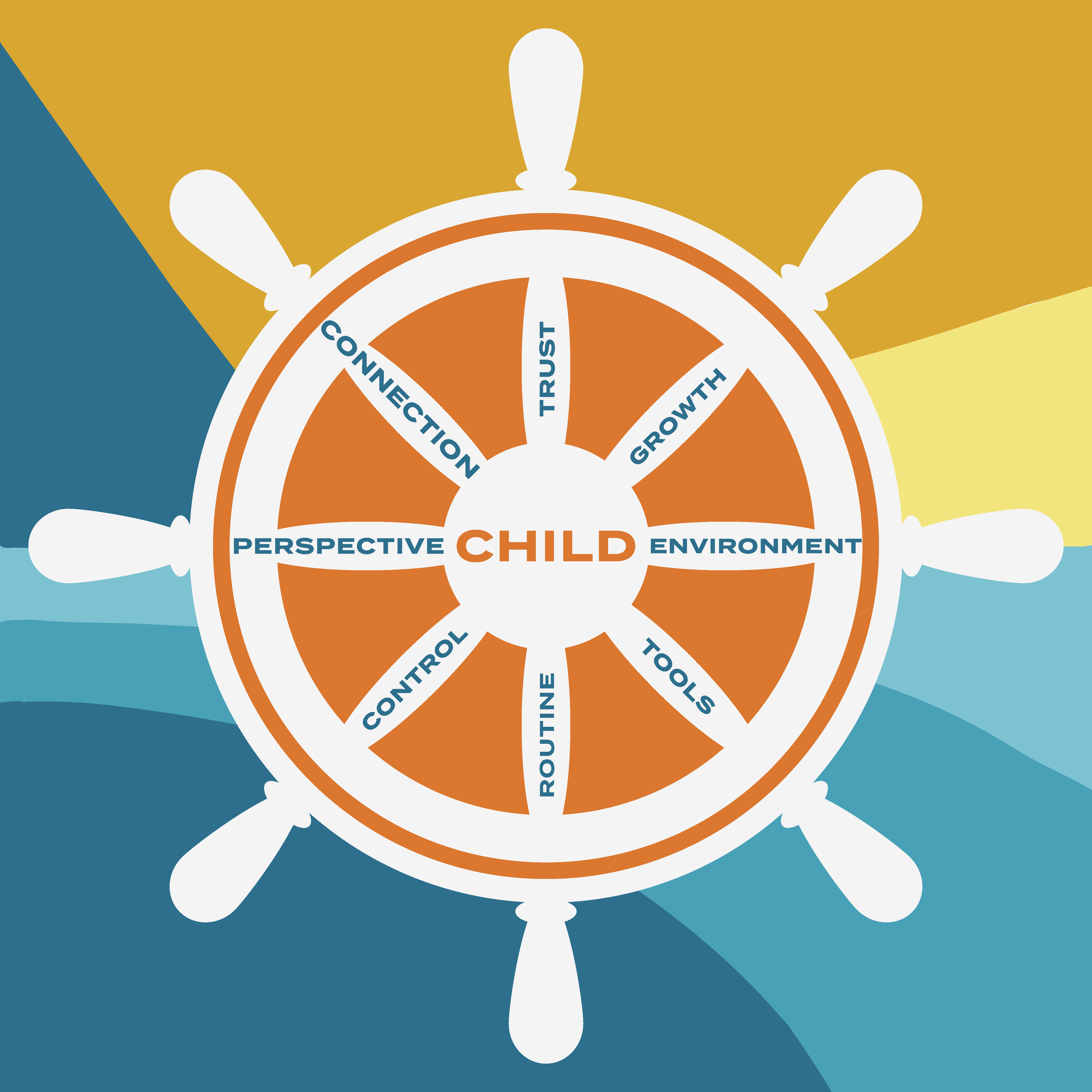
Helm: Perspective & Environment
'Tis the season. And for most of us, 'tis the season of spending.
Every year the holidays roll in and bring so much with them: traditions, family, good food, time together, and a break from our usual routines that we all look forward to. But they bring something else too. There's the stress and the overwhelm, the expectations we pile on ourselves, the spending we know is coming, and the constant juggle of time and health so we don't end up overworked and overbooked. It's a lot! And staying steady and healthy really matters, because our kids need that from us, maybe even more than they need one more thing under the tree.
The Parenting Helm is our guide for navigating all the parts of parenting, and its spokes are meant to balance each other: Control + Growth, Connection & Tools, Routine and Trust, and Perspective & Environment. Last month, in Hands on the Helm, we asked what our children need most right now. This month, with the holidays here, we're turning to Perspective & Environment. What happens when we look at this season from a different angle, and what kind of environment are we creating for our kids when their world is already so full?
When They Already Have Everything
It's a strange time to try to make the holidays feel special.
Our kids have so much. They seem to get what they want all year long, and Amazon can have it on the doorstep by tomorrow. They have the toys, the sports, and the travel, plus the coolest shoes and the nicest bikes. They look great and they're having a great time, and I don't say that as a criticism, because I'm right there in it too. I know exactly what's on Amazon!
That's part of why December can feel so odd. We want to mark the season and make it feel different from any regular Tuesday in March. But when the getting happens all year, the holidays can start to feel like more of the same, just louder, pricier, and more exhausting.
Even finding time to shop has become its own kind of tired. The stores feel picked over, almost everything lives online, and I catch myself wishing we could go back to a simpler kind of gift-giving.
What They Played With 100 Years Ago
I recently read an article about the gifts children received a hundred years ago, and it got me thinking. So many of those toys were simple, and they asked something of the child.
Tinkertoys came out in 1914 and Lincoln Logs followed in 1916, and neither one arrived as a finished product. They handed kids the materials and let them build whatever they dreamed up. A Raggedy Ann doll, first patented in 1915, was just a cloth body with yarn hair and an embroidered face, nothing like the interactive dolls so many kids have now. Even a kaleidoscope, with its mirrors and bits of colored glass, was simply a new way of looking at patterns and color.
I'm not suggesting we all run out and buy Lincoln Logs, although I love a gift that still leaves room for a child to invent. What strikes me is how little those toys tried to do for the child. They made space for play and let kids do the imagining themselves.
Which brings me back to the question I keep coming back to: What do our children really need?
I don't think the answer is more. Most of the time, I think they need us. They need us rested enough to actually enjoy them. They need slow, unhurried time and a little space to make something out of what they already have. They need the traditions, the food, the people, and that feeling of being together. The stuff is optional, but our steadiness isn't.
Keeping it Simple
This isn't about a gift-free December. I love giving gifts, and I love the look on a child's face when something was chosen just for them. But I'm trying to shrink the season back down to something we can actually hold.
Here's what I'm holding onto this year:
- One or two open-ended gifts that let them build, invent, or imagine, instead of a pile of things that already know what they are.
- Time together that isn't a transaction, like a walk, a game at the kitchen table, or staying in pajamas a little longer just because we can.
- A little less shopping, and a little more noticing what they already love and already have.
- Some protected space on the calendar, so we don't stumble into the new year worn out and wondering where the break went.
None of this is fancy, and that's exactly the point. Maybe a full season doesn't have to mean more spending, more rushing, and more of everything. Maybe it can mean a simpler environment and a clearer sense of what this time of year is really for.
Our children don't need us to give them the perfect holiday. They need us well enough, present enough, and steady enough to share it with them.
Wishing you a season that feels full in all the right ways!